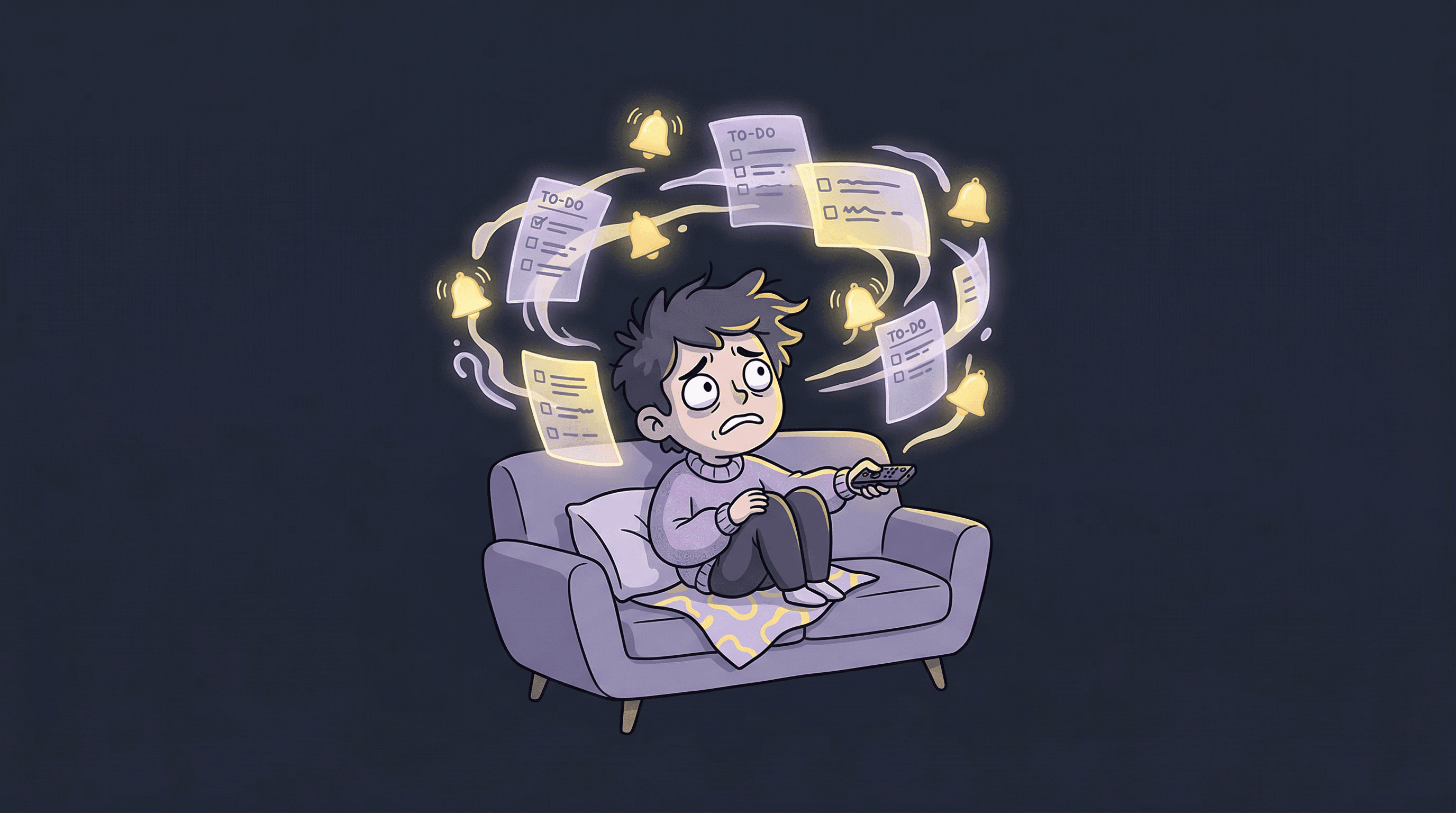
You got The Guilt Gremlin, which means right now — in this exact moment — a part of your brain is whispering that you should be doing something more productive than reading your quiz results. It's always there, isn't it? That persistent, low-grade hum of "you should be doing something else." Not anything specific. Just... something. Something more. Something better. Something that proves you deserve to take up space in this world.
Welcome to the club nobody wants to join but everybody recognizes.
The Guilt Gremlin is the most insidious of the toxic productivity types because it doesn't look like toxicity from the outside. You're not posting hustle culture quotes on LinkedIn. You're not bragging about your 5 AM routine. You're quietly, privately torturing yourself every time you sit down to watch Netflix, because somewhere in the back of your mind a voice is calculating how many "productive hours" you're wasting.
Psychologically, what you're experiencing is a textbook manifestation of what researchers call "should-based thinking" — a cognitive distortion where your internal narrative is dominated by what you should be doing rather than what you want to be doing or even what makes rational sense. It's closely linked to what clinical psychology identifies as "moral perfectionism": the belief that you must always be maximizing your potential, and that failing to do so is not just inefficient but morally wrong.
The origins of this pattern are often heartbreakingly relatable. Many Guilt Gremlins grew up in households where rest was subtly or overtly shamed. Maybe you heard "must be nice to just sit around" one too many times. Maybe love was implicitly conditional on being useful — helping with chores, getting good grades, being the "responsible" one. Your child brain learned a devastating equation: productivity = worthiness. And your adult brain never unlearned it.
Here's what makes your pattern particularly cruel: you're not even enjoying the productivity. When you do give in and work instead of rest, there's no satisfaction. Just temporary relief from the guilt, quickly replaced by exhaustion, quickly replaced by more guilt about being too tired to be productive. It's a hamster wheel powered by shame, and you're the hamster and the wheel and the cage all at once.
In relationships, The Guilt Gremlin creates a subtle but corrosive dynamic. You struggle to be fully present because your mind is always somewhere else — on the task you didn't finish, the email you should send, the workout you skipped. Partners often describe feeling like they're competing with an invisible to-do list for your attention. And when they encourage you to relax? You smile and nod and feel even worse about the fact that you can't.
You probably also have a complicated relationship with hobbies. You can't just enjoy painting. It has to become a side business. You can't just read for fun. It has to be a "personal development" book. Everything leisure must be laundered through the filter of productivity to be acceptable, which means nothing is ever actually leisure.
The growth edge for your type is the most counterintuitive: you need to practice doing nothing without earning it first. Not "rest because you've been productive enough to deserve it." Rest because you're a human being and human beings need rest. Full stop. No justification required.
Start by noticing the guilt without obeying it. Name it out loud if you need to: "There's the guilt again." Don't argue with it. Don't try to logic it away. Just notice it, like weather passing through, and choose rest anyway.
The hardest thing you'll ever learn isn't a new skill or a productivity hack. It's three words your brain has been blocking since childhood: you're enough already. Not productive-enough. Not busy-enough. Not earned-my-rest-enough. Just... enough. Start there.