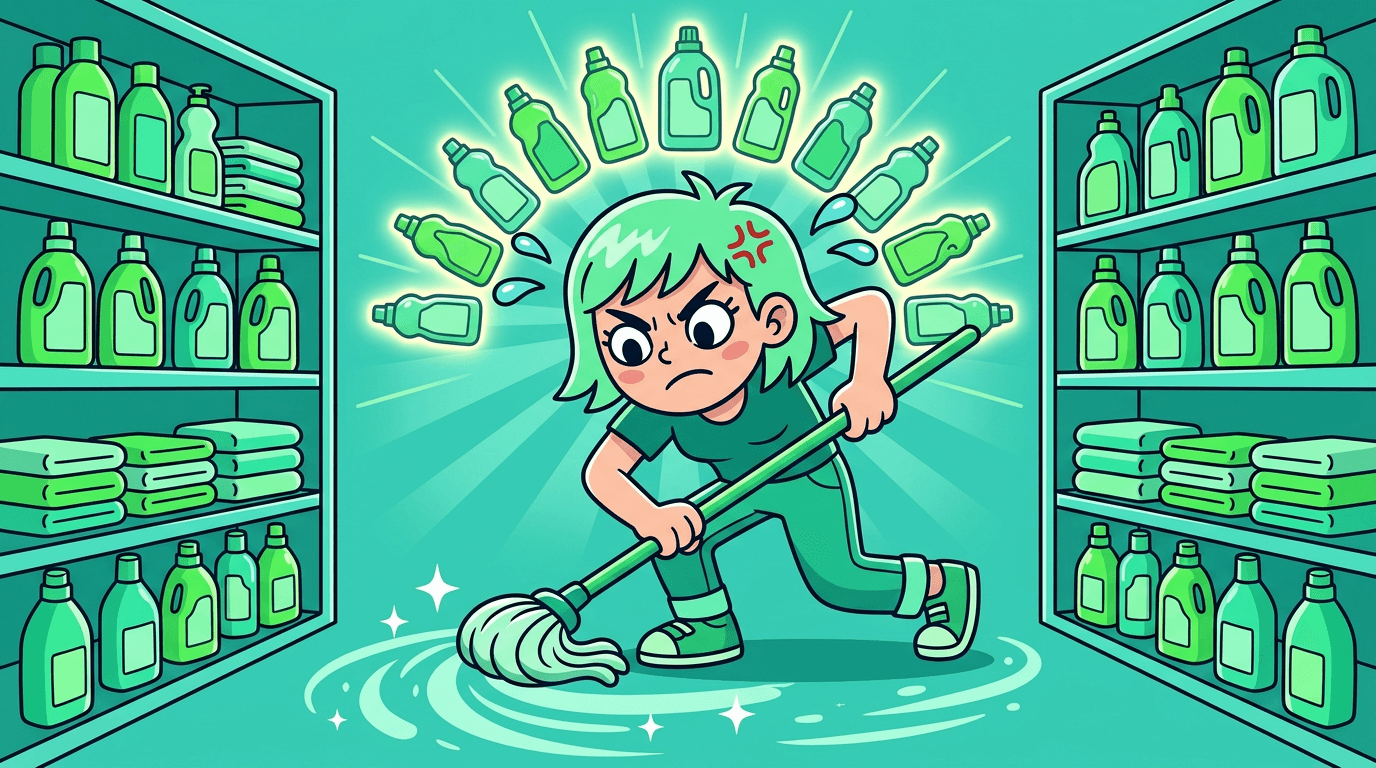
Your kitchen counter has never been cleaner, and that is a massive red flag.
Being The Rage Cleaner means you've channeled your entire emotional landscape into one question: can I scrub this feeling away? And the terrifying answer is that sometimes it actually feels like you can. There's something deeply satisfying about taking the chaos inside your head and imposing order on the physical world around you. Can't control your life? Fine. But this bathroom is going to be spotless, and god help anyone who puts a cup down without a coaster.
Psychologists call this sublimation — redirecting socially unacceptable impulses (like screaming into the void or flipping a table) into socially acceptable activities (like alphabetizing your pantry with a label maker at midnight). Sigmund Freud would have been obsessed with you. You've taken one of his most classic defense mechanisms and turned it into a lifestyle brand. The difference between you and a regular clean person is that a regular clean person cleans because the apartment is dirty. You clean because your soul is dirty and the apartment is the closest thing you can disinfect.
The control element is key here. Most Rage Cleaners share a common trigger: feeling powerless. When something in your life spirals beyond your ability to fix it — a relationship falling apart, a career stalling, a family situation you can't change — your brain panics and goes looking for SOMETHING it can control. Enter your apartment. Your apartment doesn't talk back. Your apartment doesn't have complicated emotions. Your apartment just sits there and accepts whatever organizational system you violently impose on it at 1 AM.
And here's the part nobody talks about: the aggression is real. You're not gently tidying. You're stress-scrubbing the shower like it personally wronged you. You're reorganizing the bookshelf with an intensity that would concern a casual observer. The physical exertion actually serves a dual purpose — it burns off adrenaline AND produces endorphins, making cleaning the closest thing to a legal, productive fight-or-flight response. You've essentially gamified your stress response into a chore chart, and your apartment is the accidental beneficiary.
The impact on relationships is sneaky. On the surface, people think you've got it together. "Wow, your place is so clean!" they say, not realizing they're basically complimenting your mental breakdown. Partners might initially love that you're so organized — until they realize that every intense cleaning session corresponds to an emotional crisis you're not talking about. The mop is your therapist. The vacuum is your journal. And the label maker is your emotional support animal.
The dangerous part is when the cleaning stops working. Because eventually, the apartment is clean, the closet is organized, the fridge is labeled, and you still feel like garbage. Now what? Some Rage Cleaners escalate — starting to clean other people's spaces uninvited, or reorganizing things that didn't need reorganizing, or developing actual compulsive cleaning habits that cross the line from coping into disorder. The gap between "stress cleaning" and "I cannot stop" is smaller than you think.
The growth direction isn't about cleaning less — the cleanliness is genuinely just a bonus side effect. It's about learning to process the emotion BEFORE reaching for the sponge. When you feel the urge to aggressively organize, pause and ask yourself: "What am I actually angry about?" Because the answer is never "the state of this countertop." The countertop is innocent. The countertop is a proxy for whatever you're too overwhelmed to confront directly.
You don't need to stop cleaning. You need to start talking — or writing, or screaming into a pillow, or whatever lets the emotion exit your body without first being filtered through a bottle of all-purpose cleaner. Your apartment can be both clean AND emotionally honest. Revolutionary concept, apparently.