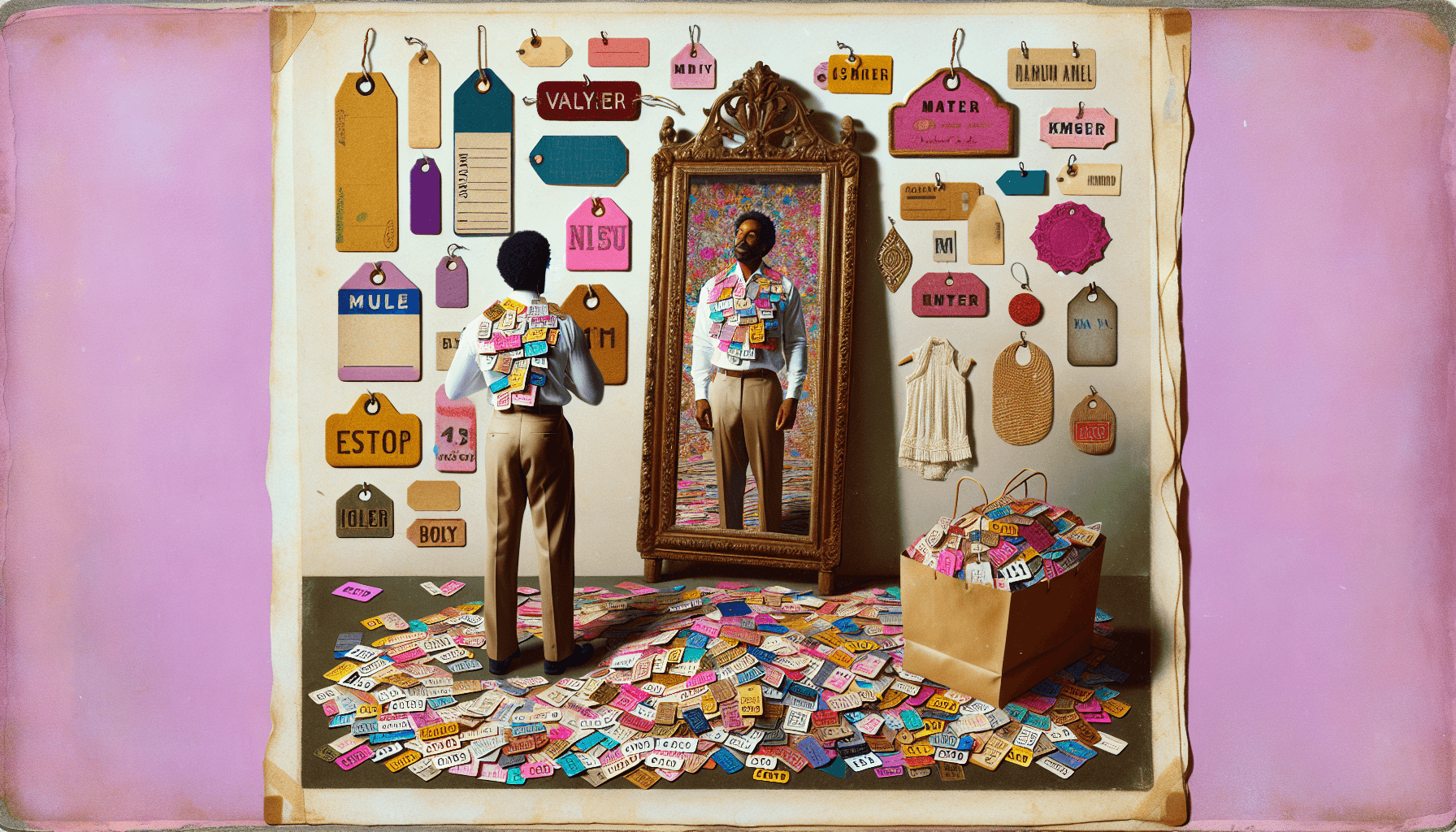
You have taken this quiz before. Not this specific quiz — but this quiz. The one that promises to finally tell you who you are. You have taken dozens of them, maybe hundreds. And every time, there is a moment right before the result loads where your chest gets a little tight, because this might be the one. The label that clicks. The description that makes you exhale and think: yes. That is me. That is exactly who I am. And then the result comes, and it is close but not quite. So you go back and change two answers. The ones where you were torn anyway. That is not cheating — those answers could have gone either way, and this version is more honest, probably. The new result loads. Better. But still not perfect. Maybe if you try one more time, with a different mindset, maybe on a different day when you are feeling more like yourself...
This is not about being indecisive, even though it can look that way from the outside. What you are doing is something psychologists call “identity shopping” — the ongoing search for an external framework that matches an internal sense of self that you cannot quite articulate on your own. You know who you are. You feel it. You just cannot find the words, and you are hoping some algorithm will find them for you.
The modern internet is designed for people like you. Every week there is a new framework, a new quiz, a new way to slice identity into categories. Attachment styles, love languages, chronotypes, Ayurvedic doshas, Human Design, gene keys — the buffet never closes. And each new system offers the same implicit promise: this is the one that will finally make you legible to yourself.
The reason no framework ever quite fits is not because you are too complex for labels — although you probably are, because everyone is. It is because you are looking for a label that captures not who you are, but who you want to be. The retaking is not about accuracy. It is about aspiration. You are not answering “which of these sounds most like me?” You are answering “which of these sounds most like the version of me I am trying to become?” Those are fundamentally different questions, and no personality quiz is designed for the second one.
This creates a particular kind of relationship with identity: fluid, restless, and perpetually unsatisfied. Your sense of self is not a fixed point. It is a moving target. People who are more settled in their labels — the Collectors with their spreadsheets, the Evangelists with their certainty — can seem almost alien to you. How do they just pick one and commit?
The truth that might set you free is counterintuitive: the search for the perfect label is the label. You are not a person who cannot find their type. You are a person whose type is searching. The restlessness, the retaking, the chronic sense that the real you is always one quiz away — that pattern is more defining than any result you have ever gotten. It is not a failure to find yourself. It is a way of being.
Your growth edge is not finding a better framework. It is making peace with approximation. Let a label be 70% right and still be useful. Let yourself be described imperfectly and not feel the need to correct the remaining 30%. The part that does not fit any category is not a problem to solve. It is the part that makes you irreducibly, uncategorizably you.