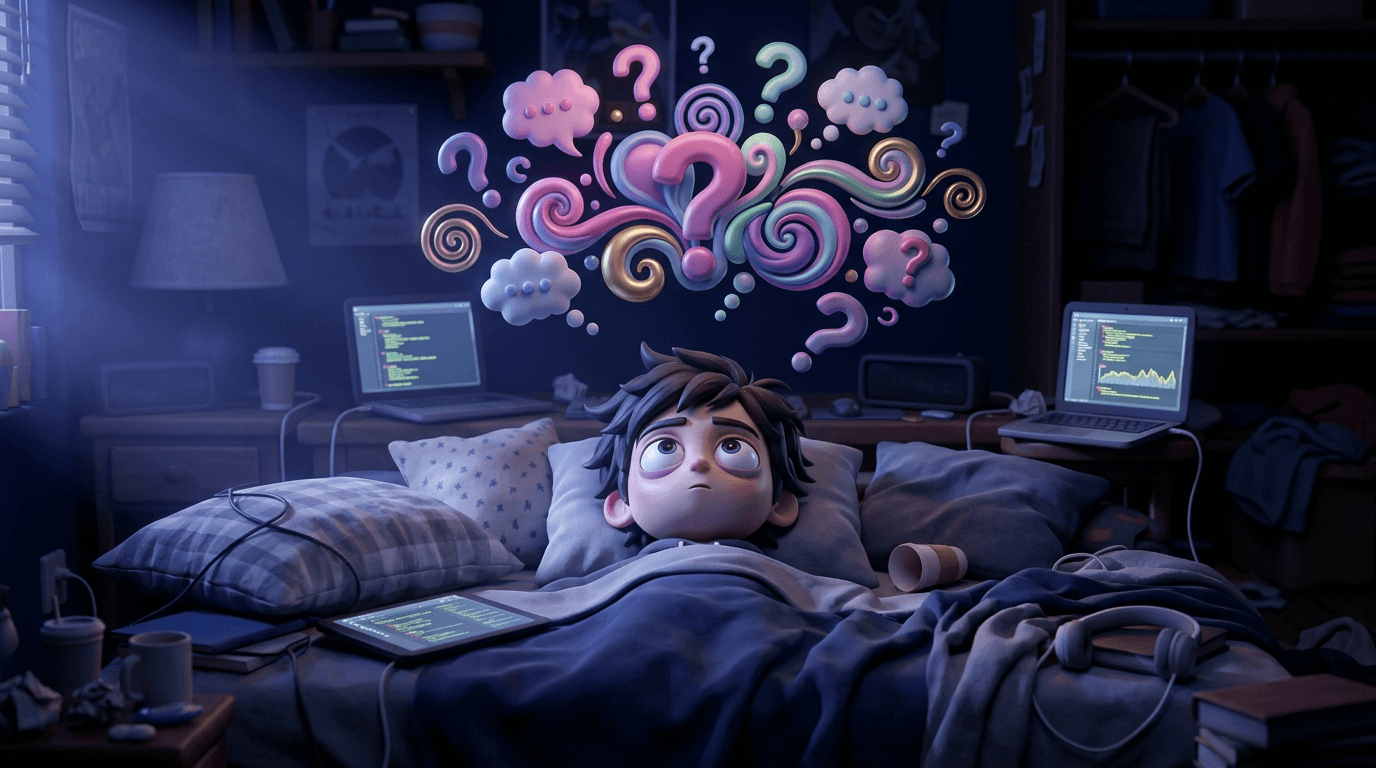
You're lying in a dark room. Phone is down (or at least face-down, which counts). Eyes are open. And your brain has decided that right now, at 1:23am, is the perfect time to revisit that slightly weird thing you said in a meeting six months ago, wonder whether your friends actually like you, contemplate the heat death of the universe, and rewrite the ending of a conversation from 2019 where you definitely should have said something different.
The Ceiling Fan Philosopher doesn't procrastinate bedtime with activities. You procrastinate it with consciousness itself. You're not doing anything that would show up on a screen time report. You're just... awake. Aggressively, unnecessarily, existentially awake. And it's the hardest type to address because there's nothing to "quit" or "cut back on." You can't delete your own thoughts (yet).
Psychologically, this pattern is closely linked to what clinicians call "cognitive hyperarousal" — a state where the mind is too activated to transition into sleep, even when the body is exhausted. But calling it "hyperarousal" makes it sound dramatic. What it actually feels like is lying there while your brain runs a PowerPoint presentation you didn't ask for, covering topics ranging from "social mistakes of 2017-2025" to "what if I'm fundamentally unknowable." Fun stuff.
The roots usually go deep. Ceiling Fan Philosophers tend to be people who don't have adequate emotional processing time during the day. If you're busy, socially engaged, or high-functioning anxious, you're likely suppressing or postponing emotional material from morning to night. When you finally lie down and remove all external stimulation, your brain goes, "GREAT, let's deal with all of that now." It's not insomnia in the traditional sense — it's unprocessed emotional debt collecting interest.
Relationships get complicated here because the Ceiling Fan Philosopher often appears "fine" during the day. You're functional, you're social, you're engaged. The existential spiral is invisible to everyone except you (and maybe the person lying next to you who can tell you're awake by your breathing pattern). Partners often don't understand why you're tired because they didn't see you fight a psychological war between 1am and 4am. The disconnect between your internal experience and external presentation can create a loneliness that feeds right back into the nighttime spiral.
There's also a relationship between this type and emotional avoidance during waking hours. If you notice that your midnight thought spirals often involve emotions you didn't express — anger you swallowed, sadness you postponed, vulnerability you deflected with humor — that's not a coincidence. Your brain is trying to complete emotional cycles that got interrupted. The ceiling fan staring is your psyche's attempt at therapy, just with worse timing and no professional guidance.
Growth for the Ceiling Fan Philosopher is probably the most therapy-adjacent of all four types. Journaling before bed (even five minutes of brain-dumping) can significantly reduce cognitive arousal by giving those thoughts somewhere to go besides the inside of your eyelids. Processing emotions in real-time during the day — even just naming them ("I'm frustrated," "that hurt") — reduces the backlog that avalanches at night.
But here's the truth most productivity advice won't tell you: some of your best self-understanding happens in those dark, quiet hours. The problem isn't that you think at night. The problem is when the thinking becomes perseverative rather than productive — when you're rehearsing the same regret for the 400th time instead of actually processing it. Learning to distinguish between reflection and rumination is your real project. One builds self-awareness. The other just builds exhaustion.
Your brain isn't broken. It's just running the emotional operating system update at the worst possible time.