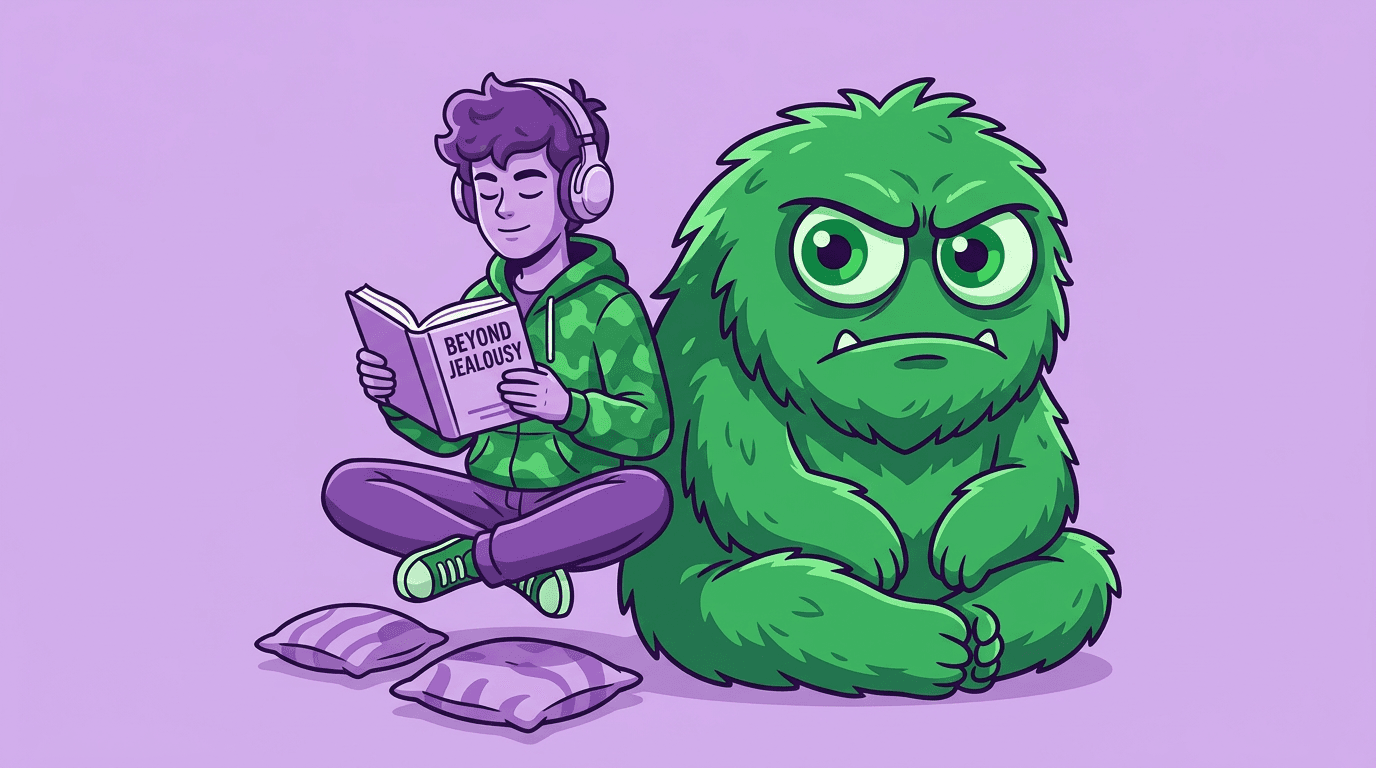
The Enlightened Denier. The person who has read enough psychology books, listened to enough podcasts, and done enough "inner work" to have intellectually transcended jealousy. Congratulations. You've achieved what centuries of Buddhist monks spent lifetimes pursuing. Or — and hear me out — you've just gotten really, really good at rebranding suppression as enlightenment.
Your signature move is the reframe. Partner has a close friend of the opposite sex? "I trust them completely, and if I feel jealousy, that's my work to do." Friend succeeds where you failed? "I practice abundance mindset — there's enough success for everyone." Seeing your ex thriving? "I genuinely want the best for them." And the wildest part? You actually believe yourself. In the moment. On the surface. Three layers of consciousness down, it's a different story entirely.
What you're doing has a name in psychology: intellectualization. It's a defense mechanism identified in psychoanalytic theory where you process emotional threats through cognitive frameworks rather than actually feeling them. You convert raw, messy, inconvenient emotions into tidy, therapist-approved narratives. It looks like emotional intelligence. It is, technically, emotional avoidance wearing a very convincing disguise.
The Enlightened Denier pattern often emerges in people who've done some therapeutic work — enough to learn the language but not quite enough to go to the uncomfortable places that language describes. You know what "attachment wound" means. You can identify "projection" in real-time. You've got the vocabulary of emotional mastery without the felt experience of actually sitting in the discomfort. It's like having a black belt certificate without ever having been punched.
What makes this tricky is that your strategy partially works. The reframes do reduce acute distress. The intellectual processing does prevent some destructive behaviors. You're not stalking anyone's profile at 3 AM (probably) or starting petty competitions. From the outside, you look healthy. From the inside, there's a persistent low hum of unacknowledged feeling that you've gotten so used to ignoring, you've forgotten it's there.
The tell is usually physical. Your jaw tightens. Your sleep gets slightly worse. You find yourself being subtly critical of the person you're "not jealous of." You intellectualize harder, read another article about attachment theory, maybe repost a quote about emotional maturity. The feelings don't go away — they just dress up in academic citations.
The growth edge for you is almost paradoxical: you need to become less "evolved." Let yourself be jealous without immediately turning it into a TED Talk. Sometimes jealousy is just jealousy — ugly, petty, irrational, and completely incompatible with your carefully curated emotional brand. And that's fine. The people who truly love you don't need you to be a walking psychology textbook. They need you to be a person. A full, messy, occasionally petty person who can say "yeah, I'm jealous and I hate it" without adding a bibliography. That vulnerability you've been theorizing about? Time to take it off the shelf and actually try it on. It'll fit weird at first. That's how you know it's real. Start with something small: admit to one person that something made you jealous. No analysis, no reframe, no "but I know it's my attachment style." Just: "That made me jealous and I hated it." Watch what happens. It's usually a hug, not a lecture.