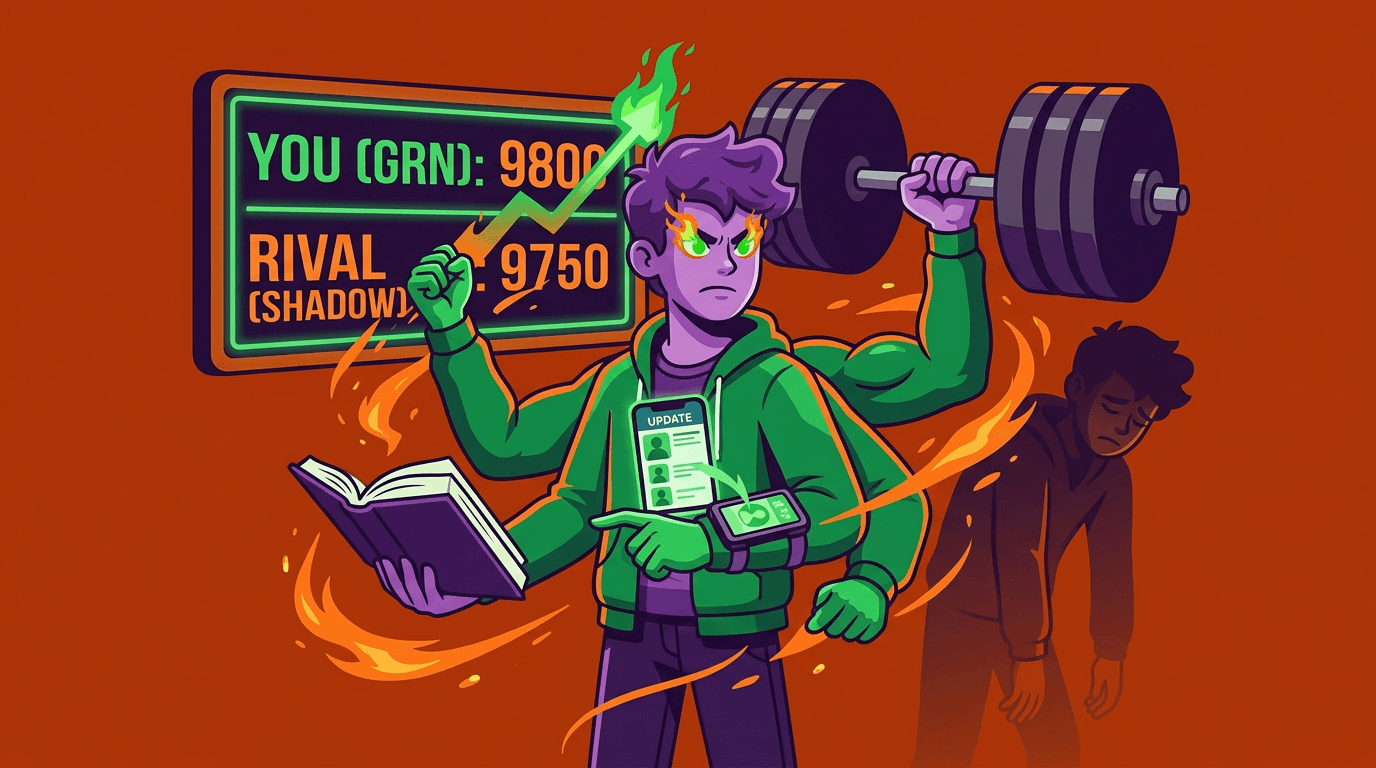
Ah, The Competitive Redirect. You beautiful, terrifying, high-octane machine. While other people sit with their jealousy and journal about it, you've already converted yours into a 90-day self-improvement plan with measurable KPIs and a Spotify playlist titled "Revenge Arc." Your jealousy doesn't make you sad. It makes you dangerous. In the most productive way possible. Usually.
Your operating system is straightforward: feel threatened → identify the axis of threat → become undeniably superior on that axis. Someone's partner is more attractive? You're in the gym before sunrise. A colleague got the promotion? You're upskilling until you're overqualified for their boss's job. Your ex moved on first? You're about to have the most aggressively curated, suspiciously perfect social media presence anyone has ever seen. You don't wallow. You weaponize.
Social psychologists would recognize this as "upward social comparison with a competitive response." While most people who compare upward feel deflated, you belong to a subset that uses the comparison as motivational fuel. Research on "benign envy" versus "malicious envy" by Niels van de Ven suggests your pattern sits right on the border — you're not trying to tear anyone down, but you are absolutely trying to surpass them, and the distinction can get blurry when your competitive drive hits redline.
The upside is obvious and real. You're probably accomplished. You've probably achieved things specifically because someone else's success made you refuse to be left behind. Jealousy has been your unofficial career coach, fitness trainer, and style consultant. People admire your drive without knowing it's powered by a green-eyed reactor core running at 110% capacity.
But here's what nobody talks about: the competitive redirect means you never actually process the jealousy. You transmute it into action so fast that you skip the part where you ask yourself why you feel threatened in the first place. Under all that productive fury is usually a belief that your value is conditional — that you're only worth something if you're winning, achieving, outperforming. Rest feels like falling behind. Being average feels like dying.
The exhaustion is real and it's cumulative. You can't outperform your way out of an insecurity that lives at the identity level. At some point the revenge glow-up has to end and you have to sit with the human underneath — the one who felt jealous not because they weren't enough, but because they were afraid of being left behind.
The growth here isn't about killing your competitive fire — that engine is genuinely magnificent and has gotten you further than most people dare to dream. It's about learning to rest without feeling like you're falling behind. About being average at something on a Tuesday and not treating it as a personal emergency. You're allowed to just... exist sometimes. Without a scoreboard. The people who love you aren't ranking you. They never were. And you'd know that if you stopped sprinting long enough to look around. Your next challenge, should you choose to accept it: be mediocre at something this week. On purpose. And notice that nobody leaves.