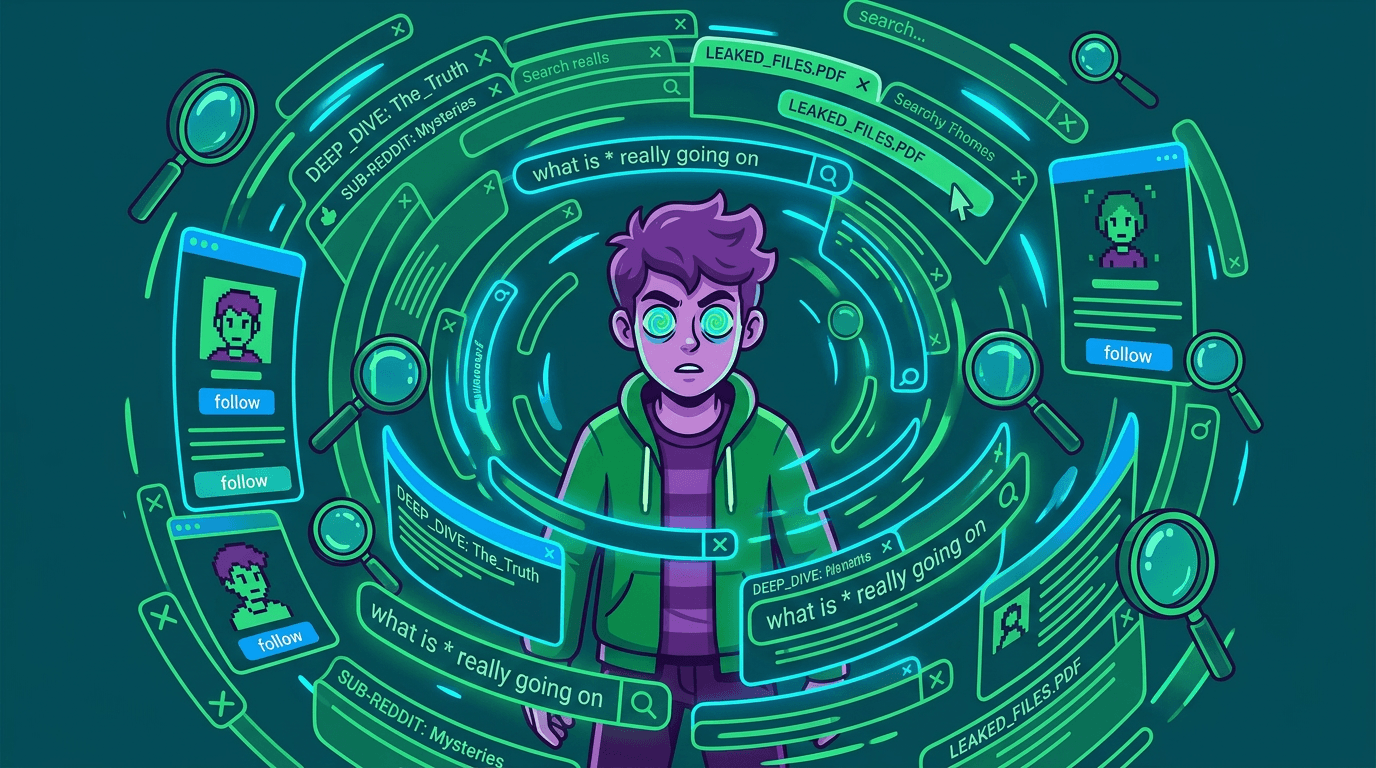
So you got The Comparison Spiral. And honestly? You probably already knew this about yourself, because knowing things is literally your whole deal. When jealousy hits you, it doesn't arrive as a feeling — it arrives as an assignment. A research project. A full-blown investigation with tabs organized by relevance and a mental murder board that would make any true crime detective weep with professional respect.
Here's how it works inside your brain: someone triggers your jealousy, and instead of sitting with that uncomfortable knot in your chest like a normal human, you immediately redirect into data collection mode. Who is this person? What do they have that you don't? How did they get it? What's their morning routine? You're not just jealous — you're conducting comparative analysis with the ruthless efficiency of a McKinsey consultant who's been personally wronged.
Psychologists call this "social comparison orientation," and research by Buunk and Gibbons suggests that people high in this trait don't just compare occasionally — they compare compulsively. Your brain has essentially automated the process. You walk into a room and within ninety seconds you've already ranked yourself against everyone present on at least four dimensions. It's exhausting. It's also weirdly impressive.
The thing about information-seeking jealousy is that it masquerades as rationality. You're not being emotional — you're being thorough. You're not insecure — you're just detail-oriented. But underneath all that research is a core belief that if you just understand enough, if you just gather enough data, you can somehow control the outcome. It's the illusion of agency in a situation where you fundamentally feel powerless.
This pattern often traces back to environments where information was power. Maybe you grew up in a household where surprises were never good, so you learned to predict and prepare. Maybe you experienced a betrayal that blindsided you, and you swore you'd never be caught off guard again. Whatever the origin, your nervous system now equates uncertainty with danger, and the only antidote it trusts is knowledge.
The dark side is real though. The Instagram deep-dives at 3 AM don't actually make you feel better — they make you feel worse and more certain that you needed to feel worse. Each piece of information feeds the spiral rather than resolving it. You're essentially scratching an itch that gets itchier the more you scratch.
The growth edge here isn't about deleting Instagram or swearing off Google (we both know that's not happening). It's about catching yourself mid-spiral and gently asking: "What am I actually afraid of right now?" Usually the answer isn't about the other person at all. It's about your own worth — and honestly? The fact that you care this much means your capacity to love is enormous. You just need to aim some of that investigative energy inward. Not to interrogate yourself, but to actually get to know the person behind all those open tabs. They're worth knowing. Try this: next time you feel the spiral starting, set a ten-minute timer. Let yourself feel the jealousy without researching it. Just sit with it. It won't kill you, even though your nervous system is absolutely convinced it will.