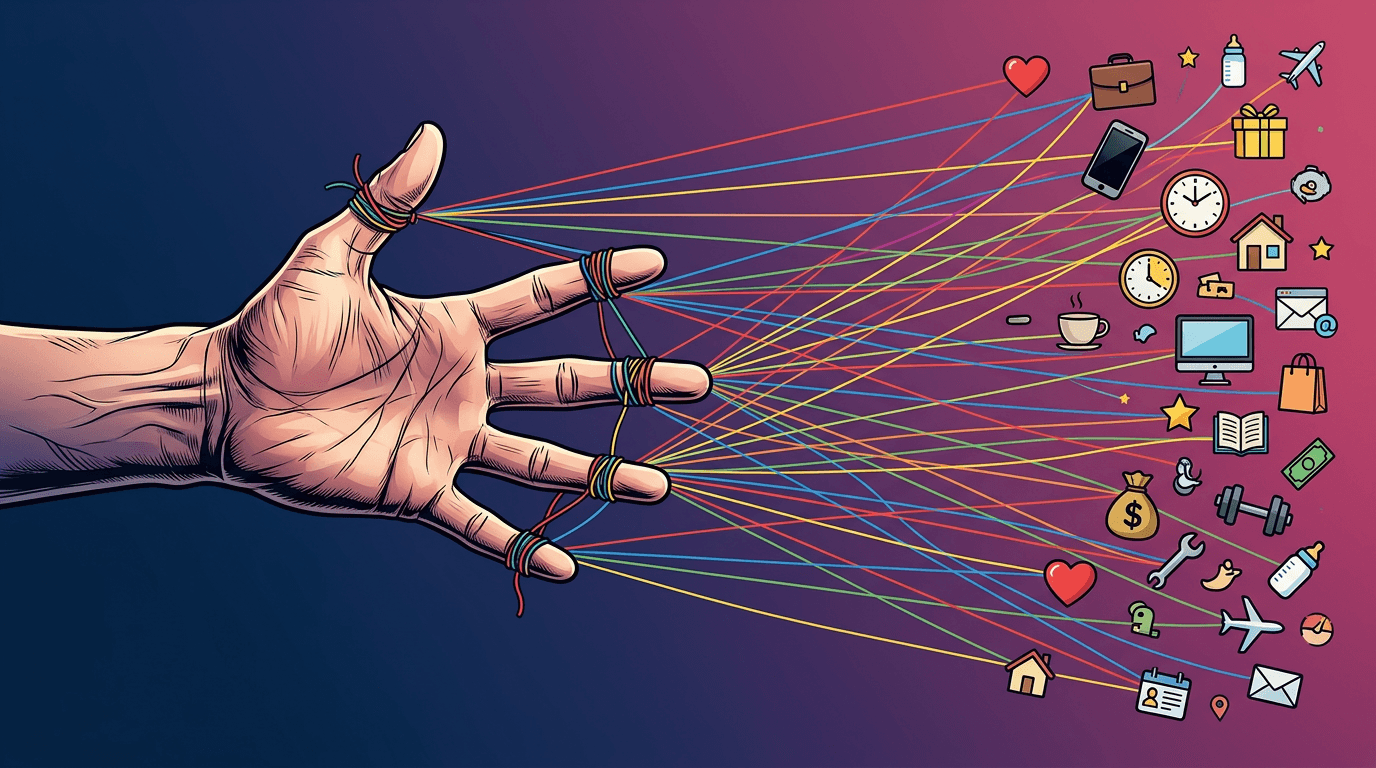
You Just Said “Yes” Again. You Hate Yourself for It.
You’re in the bathroom at work, staring at yourself in the mirror, wondering why you just volunteered to organize the office holiday party for a team of people you don’t even like. You don’t want to organize anything. You can barely organize your own lunch. But someone asked, and your mouth said “Of course! I’d love to!” before your brain could file an objection, and now you’re standing here, three minutes into a shame spiral, contemplating faking your own death to get out of it.
Sound familiar? Welcome. Population: way too many of us.
Here’s the thing nobody tells you about people-pleasing: it has almost nothing to do with being nice. Nice people help others because it genuinely feels good. People-pleasers help others because the alternative — someone being disappointed in them — feels like the emotional equivalent of being set on fire. You’re not kind. You’re terrified. And your brain has built an incredibly sophisticated anxiety management operation, dressed it up in a “helpful person” costume, and convinced you it’s your personality.
This isn’t a quirk. It isn’t a phase. It’s a survival strategy your nervous system developed when you were too young to have a say in the matter, and it’s been running on autopilot ever since. The psychology behind people-pleasing is darker, more complex, and more forgivable than you think.
Let’s rip the band-aid off.
TL;DR
People-pleasing isn’t kindness — it’s a trauma response called “fawning,” where your nervous system learned to appease others to stay safe. It usually starts in childhood with unpredictable caregivers and becomes an automatic pattern that erodes your identity, builds invisible resentment, and paradoxically makes genuine connection impossible. The fix isn’t becoming a jerk — it’s learning to tolerate the discomfort of being disliked.
The Fawn Response — Your Nervous System Chose Cowardice (And It Was Brilliant)
You know fight, flight, and freeze. But there’s a fourth stress response that doesn’t get nearly enough airtime: fawn.
Psychotherapist Pete Walker, in his work on Complex PTSD, identified the fawn response as what happens when your nervous system decides that the safest way to deal with a threat isn’t to fight it, run from it, or shut down — it’s to make the threat happy. Smile. Agree. Anticipate what they need before they ask. Become so useful, so accommodating, so impossibly agreeable that nobody has any reason to hurt you.
It’s cowardice, technically. But it’s also genius. For a kid in an unpredictable household — where a parent’s mood could shift from fine to fury in seconds — fawning was often the only strategy that actually worked. You couldn’t fight (you were five). You couldn’t flee (where would you go?). You couldn’t freeze (they’d notice). But you could become the peacekeeper, the mood-reader, the tiny emotional first responder who diffused the bomb before it went off.
The problem? Your nervous system never got the memo that you’re not five anymore. It’s still running the same program — except now the threats aren’t a volatile parent but a slightly passive-aggressive coworker or a friend who seems annoyed over text. Same fawn response. Different decade. Same exhaustion.
How People-Pleasers Are Made (Spoiler: It’s Not Your Fault. But It Is Your Problem.)
Nobody wakes up and decides to become a people-pleaser. It’s not a lifestyle choice, like going vegan or getting really into pottery. It’s something that happens to you, usually before you’re old enough to understand what’s happening.
The recipe is almost always the same: take one child, add at least one emotionally unpredictable caregiver, and marinate in an environment where love is conditional and approval must be earned through performance. Maybe your parent was explosive. Maybe they were emotionally unavailable. Maybe they were so fragile that you learned early on that YOUR feelings were a burden someone else couldn’t carry. The outcome is identical: you internalized the belief that other people’s emotions are more important than yours, and your job — your only job — is to manage them.
Psychologists call this parentification. The child-parent dynamic flips, and the kid starts functioning as the emotional caretaker of the household. You monitored your parent’s mood before you monitored your own homework. You learned to read a room before you learned to read a chapter book. Bowlby’s attachment research showed decades ago that children with inconsistent caregivers develop anxious attachment styles — constantly scanning for signs of rejection, hypervigilant about other people’s emotional states, addicted to reassurance that never quite satisfies.
Here’s the part that stings: none of this is your fault. You didn’t choose this wiring. But it IS your problem now, because it’s running every relationship you have. Your romantic partners feel like they can never truly reach you (because you’re performing instead of connecting). Your friends sense the friendship is weirdly one-sided (because you give and give and never ask). Your coworkers think you’re a pushover (because, well, you are). None of these people are seeing the real you. The real you has been buried under decades of strategic niceness.
And the cruelest part? You probably don’t even know who the real you is anymore.
The 4 Flavors of People-Pleasing (Ranked by Self-Destruction Level)
Not all people-pleasers operate the same way. Here are the four main archetypes — see which one makes you feel personally attacked.
The Chronic Apologizer. “Sorry” isn’t a word for you — it’s punctuation. Sorry for being in the way. Sorry for having an opinion. Sorry for existing in a space that someone else might prefer to use. You apologize for things that aren’t your fault, for things that aren’t anyone’s fault, and occasionally for things that are actively someone else’s fault. It’s not about taking responsibility. It’s about preemptively neutralizing any possible conflict before it can form.
The Overcommitter. Your calendar looks like a war crime and every single item on it was put there by someone else. You said yes to the project, the favor, the event, the extra shift, the “quick call,” and the road trip that you absolutely do not have time for. Saying no feels physically impossible — like the word has been surgically removed from your vocabulary and replaced with “Sure, I’d love to!” delivered through gritted teeth.
The Conflict Avoider. You would rather swallow your own feelings whole — bones and all — than risk a single uncomfortable conversation. Disagreement isn’t just unpleasant for you. It’s existentially threatening. So you agree, defer, accommodate, and smile your way through interactions that are slowly corroding you from the inside. The peace you maintain is technically real. But it’s a graveyard peace — built on the burial ground of every honest thing you’ve ever wanted to say. You sacrifice your own truth on the altar of keeping things “fine.” The flowers growing on that grave? Beautiful. Also fake. Also growing from the decomposing remains of your self-respect.
The Emotional Sponge. Your friend is stressed? Now you’re stressed. Your partner is anxious? Congratulations — you’ve absorbed their anxiety like emotional WiFi and your own battery just dropped to 3%. You don’t just empathize with other people’s feelings. You download them. Entirely. Without consent. Every mood in the room becomes your responsibility to process, fix, or at minimum endure. Other people leave conversations feeling lighter because they unknowingly dumped their emotional weight onto you, and you just… carried it. You’re a human router for other people’s feelings, and your own bandwidth ran out years ago. The worst part? Nobody asked you to do this. Your nervous system volunteered.