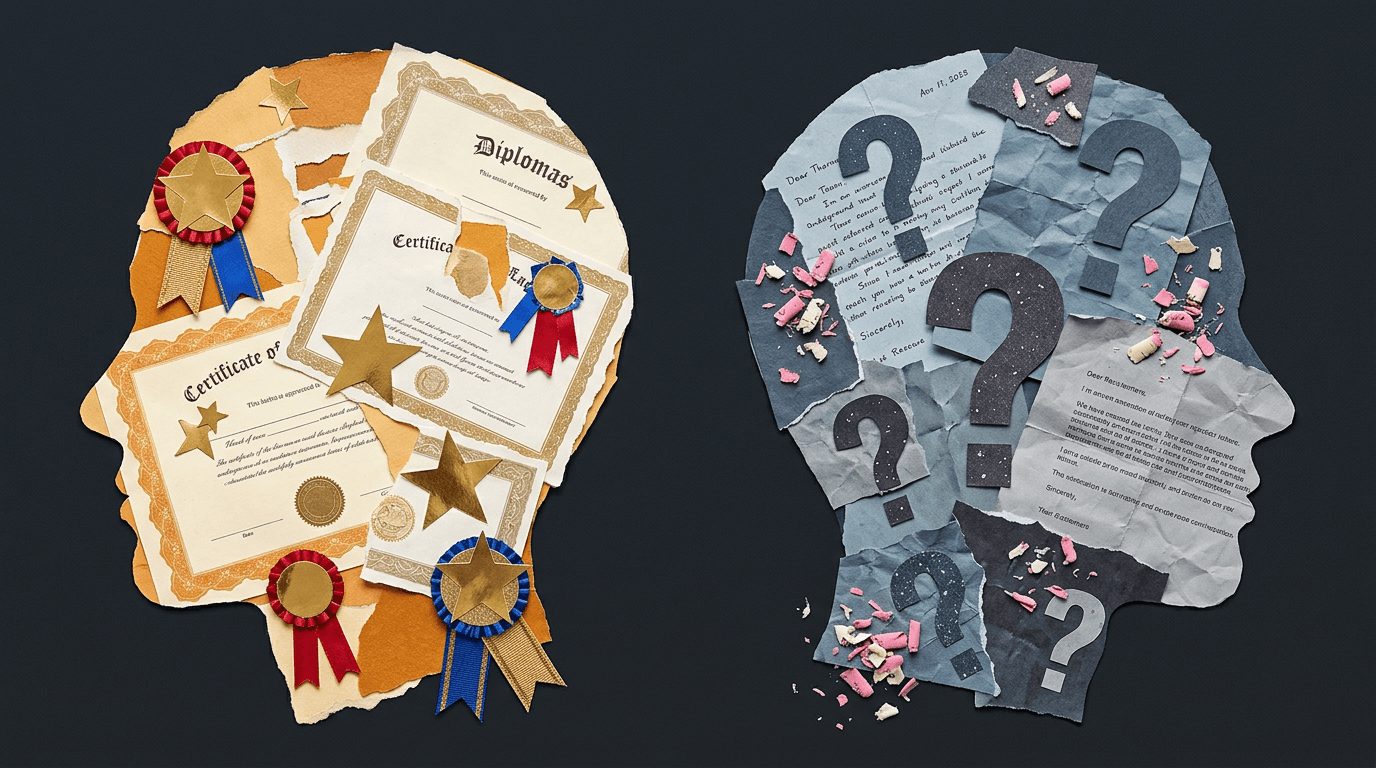
You’re Reading This Because You Think You Don’t Deserve To
You got the job. The acceptance letter. The promotion. And your very first thought wasn’t celebration — it was a cold, quiet voice whispering: they’re going to find out.
Find out what, exactly? That you’re not as smart as your résumé suggests. That you’ve been coasting on luck, timing, and the inexplicable goodwill of people who haven’t yet realized you’re faking it. That any day now, someone will tap you on the shoulder and say, “We need to talk.”
If this sounds familiar, congratulations — you’re experiencing one of the most well-documented psychological patterns in modern research. And ironically, the fact that you’re worried about being a fraud is one of the strongest indicators that you’re not one.
TL;DR: Impostor syndrome isn’t a mental illness — it’s a cognitive pattern where high-achievers attribute their success to luck and fear being “exposed.” Up to 70% of people experience it at some point. Psychologists have identified 5 distinct impostor types, and understanding yours is the first step to shutting that voice up.
The Accidental Discovery That Named Your Inner Fraud
In 1978, two psychologists at Georgia State University noticed something strange. Dr. Pauline Rose Clance and Dr. Suzanne Imes were working with a group of extraordinarily accomplished women — PhDs, department heads, published researchers — and nearly all of them believed they didn’t actually earn their positions.
These weren’t people fishing for compliments. They genuinely, deeply believed they had fooled everyone. Clance and Imes called it the “impostor phenomenon” and published a paper that would go on to reshape how we understand achievement anxiety.
Here’s the twist they didn’t expect: it wasn’t just women. Once the paper gained attention, men started coming forward too. Then students. Then CEOs. Then literal Nobel laureates. The pattern was everywhere — it had just never had a name before.
The 5 Impostor Types (And One of Them Is Definitely You)
Dr. Valerie Young spent decades studying impostor syndrome and eventually identified five distinct flavors. Think of them less as rigid categories and more as your brain’s preferred method of self-sabotage.
The Perfectionist
You set absurdly high standards, meet 95% of them, and then fixate on the 5% you missed. An A-minus feels like failure. A project that went “really well” haunts you because of that one slide you could’ve polished more. You don’t celebrate wins — you audit them for flaws.
The Perfectionist’s signature move: spending three hours reformatting a document nobody will read closely, then calling yourself “not detail-oriented enough.”
The Superhuman
You compensate for your perceived fraudulence by working harder than everyone else. First one in, last one out. You volunteer for extra projects not because you want to, but because slowing down means people might notice you’re not actually that good. Burnout isn’t a risk for you — it’s a Tuesday.
The Natural Genius
This one’s sneaky. You’ve been told you’re “gifted” since childhood, so now anything that requires effort feels like proof that you’re not. If you were really smart, it would come easily, right? You avoid challenges where you might struggle because struggling means failing, and failing means the “gifted” label was a lie all along.
The Natural Genius avoids beginner-level anything. Learning a new skill in public? Absolutely not.
The Soloist
Asking for help is admitting defeat. You believe that real competence means doing everything yourself, and needing assistance is evidence of your inadequacy. Group projects are your nightmare — not because of other people, but because collaboration means someone might see the gaps in your knowledge.
The Expert
You never feel like you know enough. Before speaking up in a meeting, you need to have read every paper, taken every course, earned every certification. You hesitate to call yourself an expert in anything because there’s always more to learn. Job listings asking for 8 out of 10 skills you have? You won’t apply. You don’t have all ten.
Most people lean heavily into one or two of these types. And if you just read all five thinking “that’s me” to each one — well, that tracks.
Why Your Brain Gaslights You
Here’s the frustrating part: impostor syndrome isn’t random. Your brain is running a very specific, very broken algorithm.
It works like this: when something goes well, you attribute it to external factors. I got lucky. The interviewer was in a good mood. The competition was weak this year. But when something goes wrong? That’s internal. I’m not smart enough. I knew I couldn’t handle this. This is the real me.
Psychologists call this an attribution error — and in impostor syndrome, it’s perfectly inverted from reality. You take zero credit for success and full credit for failure.