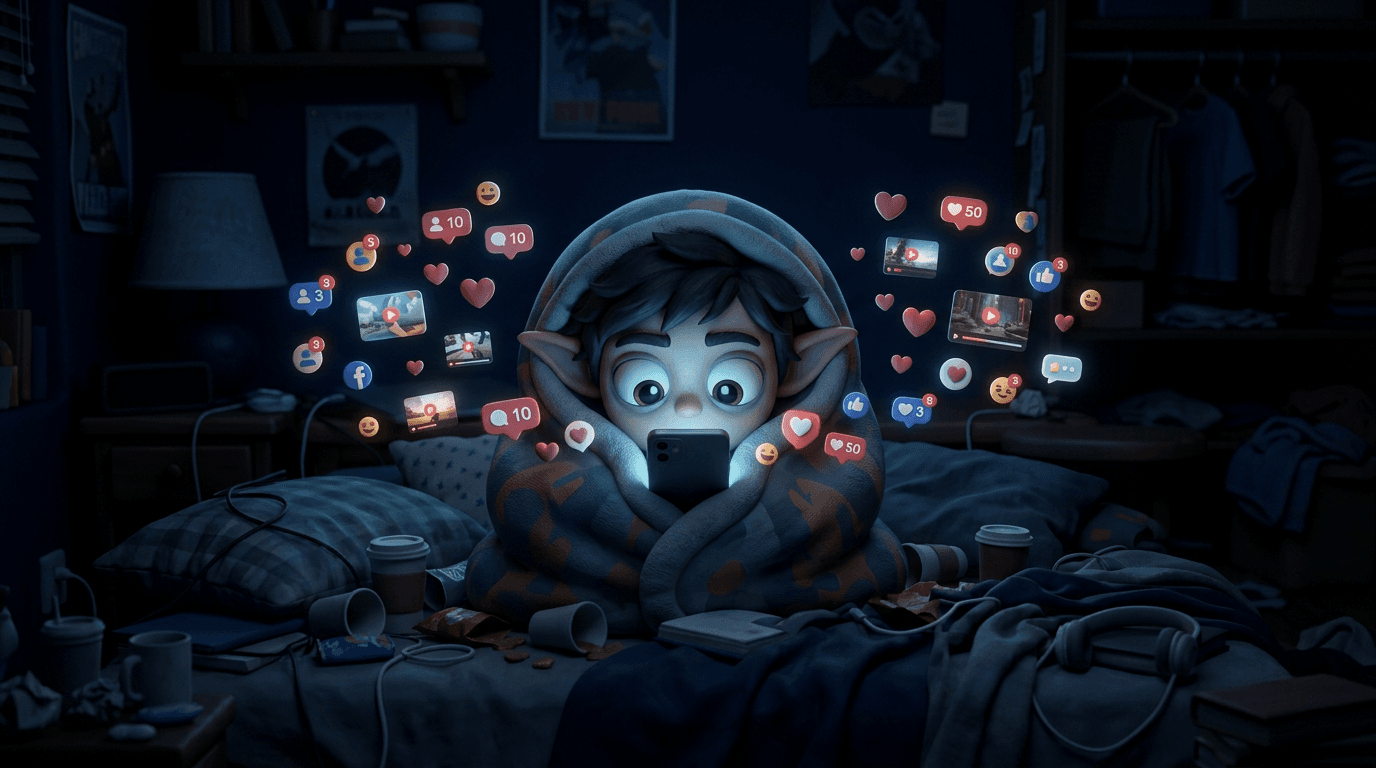
So you're the one who opens TikTok "for five minutes" at 11pm and surfaces at 3:47am having watched a man build an entire house out of popsicle sticks, a deep dive into unsolved maritime mysteries, and seventeen videos about cats who look like they pay taxes. You didn't plan this. You never plan this. And yet here you are, every single night, like a moth that knows the flame is just a YouTube algorithm.
Here's what's actually happening in that sleep-deprived brain of yours: revenge bedtime procrastination through passive consumption is one of the most common forms of emotional avoidance. When your day is packed with demands — work, socializing, responsibilities — your brain craves low-effort stimulation that doesn't ask anything of you. Scrolling is the perfect drug because it provides micro-hits of novelty and dopamine without requiring decision-making, effort, or emotional vulnerability. You're not being lazy. You're seeking the path of absolute least resistance because you're already running on empty.
The psychology behind this is fascinating and slightly terrifying. Dr. Floor Kroese, who literally coined the term "bedtime procrastination" in her 2014 research, found that the scroll-type procrastinator typically has depleted self-regulation by evening. You've spent all day making decisions, managing emotions, and being a functional human. By 11pm, the part of your brain responsible for saying "maybe stop" has clocked out. The prefrontal cortex — your impulse control center — is basically asleep while the rest of you keeps scrolling.
But there's a layer most people miss. The content you consume at 2am isn't random. It's revealing. If you're watching comfort content — cooking videos, wholesome compilations, ASMR — you're likely soothing anxiety you didn't process during the day. If it's true crime, conspiracy theories, or rabbit-hole research, you're feeding a need for cognitive stimulation that your day job doesn't satisfy. If it's relationship content or drama commentary, you might be processing social dynamics you can't engage with in real life. Your late-night algorithm is basically a mirror of your unmet emotional needs.
The relationship impact is real, even if it doesn't feel dramatic. Partners get frustrated when you're "always on your phone" but can't articulate that you're not choosing the phone over them — you're choosing numbness over consciousness. You're also consistently showing up to your life underslept, which makes you more reactive, less patient, and worse at the emotional regulation you already struggle with. It's a cycle: bad day, need to decompress, scroll until 3am, exhausted tomorrow, worse day, need more decompression. Rinse, repeat, wonder why you're always tired.
The growth edge for you isn't about willpower or screen time limits (you've already proven those don't work). It's about addressing the daytime deficit that creates the nighttime hunger. If you can carve out even 30 minutes of genuine, low-pressure personal time DURING the day — not productive time, not social time, just pure "I'm doing whatever I want" time — the midnight scroll sessions start losing their grip. Your brain doesn't need to steal those hours from sleep if it's getting them elsewhere.
Also worth noting: you probably need more transition time between "being a person" and "being asleep." Your scroll session IS your transition — it's just a wildly inefficient one. Try replacing even the first 20 minutes with something slightly more intentional (a podcast, a bath, literally anything with a natural endpoint) and you might find the scroll monster loosens its jaw a little.
You're not broken. You're just chronically under-leisured and your phone knows it.